

Southern Journalists Syndicate organizes Legal Symposium on “Electronic Publishing Crimes, Problems and Solutions”
SMA NEWS – ADEN THE CAPITAL
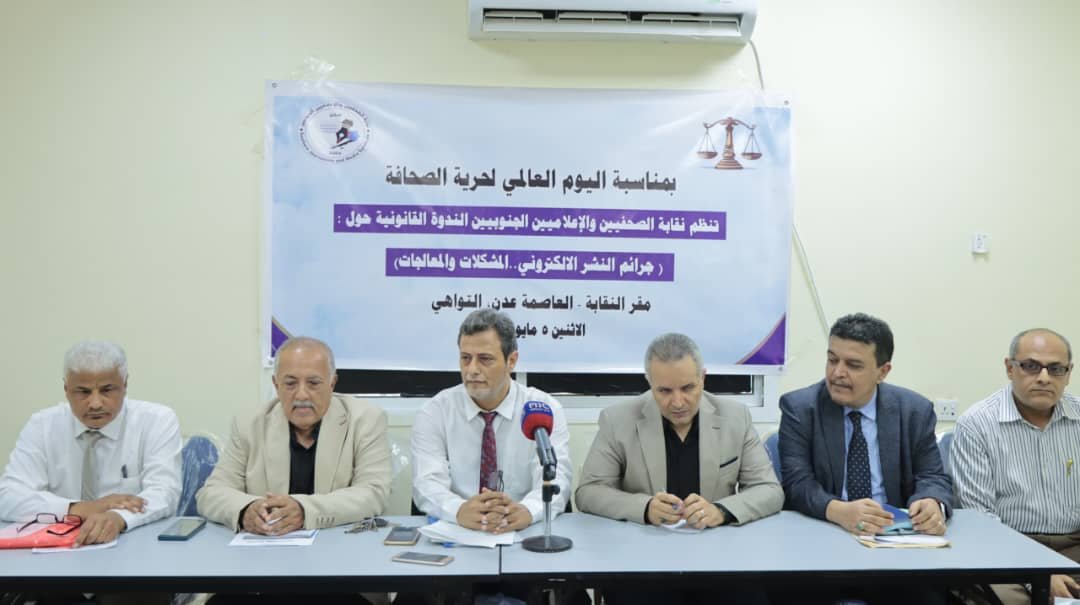
The headquarters of the Southern Journalists and Media Members Syndicate hosted a legal symposium on “Electronic Publishing Crimes, Problems and Solutions.” in which Legal papers were presented by Dr. Saleh Al-Marfadi, member of the Supreme Judicial Council; Judge Khaled Al-Hasani, Deputy Prosecutor for Press, Publications and Electronic Publishing; Dr. Abdullah Basuhaib, Professor of Criminal Law at the Faculty of Law; and Dr. Yasser Baazeb, Vice Dean of the Faculty of Journalism at the University of Aden.
In his speech during the opening session, Mukhtar Al-Yafei, Vice Chairman of the Southern National Media Authority, emphasized the importance of balancing freedom of the press and freedom of expression on one hand, and the need to adhere to the rules of legal discipline on the other. He noted that responsible media is an integral partner in achieving justice and should not be used as a cover for chaos or to harm the public interest.
He emphasized that this symposium comes at a sensitive time, with the escalating challenges associated with the digital space and the spread of hate speech and misinformation. He called for updating legislation related to electronic publishing crimes, establishing specialized courts, and developing legal and ethical codes of conduct for media professionals.
Al-Yafei also announced the National Media Authority’s support for the symposium’s recommendations, most notably the establishment of a southern observatory to monitor and analyze digital content and launch legal awareness campaigns for society and media professionals on the limits of freedom of expression and the ethics of electronic publishing.
The Vice Chairman of the Authority concluded his speech by emphasizing the importance of strengthening cooperation between the Media Authority, the Journalists Syndicate, and the judiciary to build a media system that keeps pace with the times and protects rights and freedoms, within a framework of responsibility, professionalism, and respect for the rule of law.
In the opening session, Mr. Aidarous Bahashwan, Head of the Southern Journalists and Media Members Syndicate, emphasized the importance of the symposium, describing it as exceptional in terms of the participation of judges from the Supreme Court, the Press Prosecution, and the Faculties of Law and Media, all of whom are specialists in electronic publishing and have extensive research that addresses issues of electronic publishing. The symposium concluded with the issuance of a final statement, which read:
Final Statement of the Specialized Legal Symposium on “Electronic Publishing Crimes: Problems and Solutions” was issued as follows:
Under the sponsorship and organization of the Southern Journalists and Media Members Syndicate, and with the participation of a select group of judges, prosecutors, academics, media professionals, and legal experts, a specialized legal symposium was held in the capital, Aden, entitled:
“Electronic Publishing Crimes: Problems and Solutions.” and was Held at the headquarters of the Southern Journalists and Media Members Syndicate in Aden, on Saturday, May 4, 2025.
This symposium coincided with World Press Freedom Day, which falls on May 3 of each year, and reflects the societal need to promote digital legal literacy and regulate media practices on electronic publishing platforms.
The symposium discussed a number of topics related to electronic publishing crimes, legal responses, and the impact of these crimes on societal security and media freedoms. It also addressed the practical challenges facing the prosecution and judiciary in these types of cases.
After reviewing the working papers, engaging in rich discussions, and providing specialized legal input, the symposium concluded with the following recommendations:
1. Call on judicial and legislative authorities to expedite the issuance of modern legislation specific to electronic publishing crimes, taking into account the specificities of the digital environment and maintaining a balance between freedom of expression and the protection of public order.
2. Establish specialized prosecution offices and courts for information technology and electronic publishing cases, and train judges and public prosecutors on mechanisms for handling digital evidence in accordance with international standards.
3. Draft media and legal codes of conduct that require media professionals to adhere to professional standards and ethical guidelines in publishing, and limit the phenomena of defamation, misinformation, racist and hate speech.
4. Strengthen institutional cooperation between the Southern Journalists and Media Professionals Syndicate and the judiciary to establish joint channels for consultation, address attacks on journalists, and ensure the independence of journalistic work.
5. Launch awareness programs targeting media professionals, digital activists, and the general public to promote a legal culture related to the use of social media and digital platforms.
6. Emphasize that journalists and media professionals should not be referred to the Public Prosecution in cases of press and media publication, and that the Press, Publications, and Electronic Publishing Prosecution is the legally competent authority to hear these cases, out of respect for the special nature of journalistic work, ensuring professional justice, and preventing the politicization of media practice.
7. Emphasize the need to respect national and humanitarian symbols and reject any form of abuse or insult to martyrs, activists, the wounded, or their families, under any pretext or justification. This behavior is legally and morally unacceptable, constitutes an infringement on the highest societal values, and must be subject to clear legal and societal accountability.
8. Call on educational and media institutions to incorporate the concepts of responsible electronic publishing into their curricula and programs, and develop academic research on digital crimes and electronic legislation.
9. Recommend the establishment of a Southern Observatory for Electronic Publishing to monitor violations, analyze digital content trends, and submit periodic reports to the relevant judicial and trade union authorities.
The participants affirm that ensuring freedom of the press and freedom of opinion and expression in the digital age does not conflict with the implementation of legal instruments. They also emphasize that responsible media constitutes a safety valve for protecting public values and strengthening national cohesion. They also represent a key partner in building a state of law and institutions.